
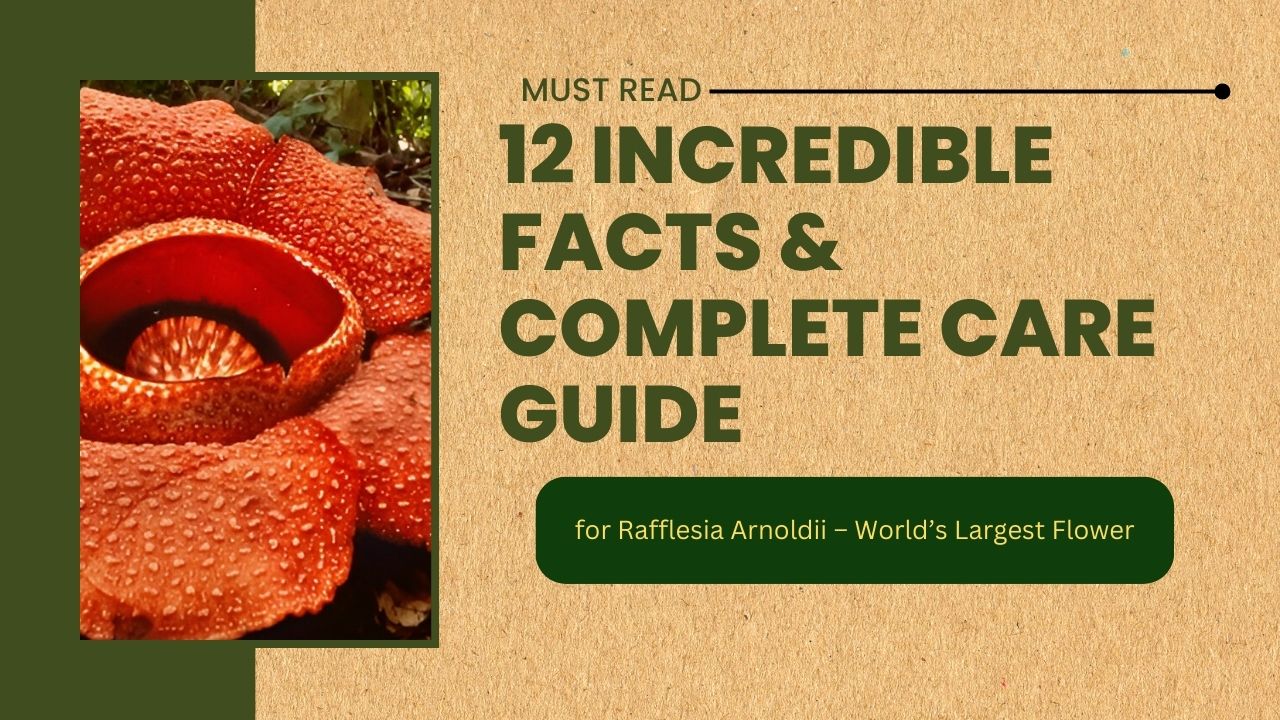
Introduction: Rafflesia Arnoldii—World’s Largest Flower with a Corpse-like Smell
The Rafflesia Arnoldii is the world’s biggest flower and is sometimes called the “corpse flower.” It is one of the rarest and most mysterious plants on Earth. This huge flower can grow to be more than 100 cm across and weigh up to 10 kg. It is mostly found in the rainforests of Sumatra and Borneo. Its strong smell, which is similar to rotting flesh, draws in pollinators like carrion flies, which makes it even more amazing.
Rafflesia Arnoldii is more than just an intriguing plant. It is an important part of the rainforest ecosystem, supports local ecotourism, affects regional economies, and is a symbol of biodiversity conservation. This in-depth guide looks at its history, biology, habitats, role in the environment, effect on the economy, cultural significance, seasonal care, and future prospects for conservation.
1. History & Discovery of Rafflesia Arnoldii
Sir Stamford Raffles and Dr. Joseph Arnold first wrote about Rafflesia Arnoldii in the Sumatran rainforests in 1818. Since then, it has become a well-known plant in Southeast Asia.
- Discovered: 1818
- Named after: Sir Stamford Raffles and Dr. Joseph Arnold
Native Regions: Sumatra, Borneo, Malaysia, Thailand, Philippines
2. Taxonomy & Morphological Features
Scientific Classification: Belonging to Rafflesiaceae, Rafflesia arnoldii was officially described in 1821 by Robert Brown, honoring Sir Stamford Raffles and Dr. Joseph Arnold.
Discovery: French explorer Louis-Auguste Deschamps first collected samples in the 1790s, but it was hard to tell who they belonged to because of lost records.
Kingdom: Plantae
- Family: Rafflesiaceae
- Genus: Rafflesia
- Species: Arnoldii
Key Morphological Facts
Structure: A holoparasitic plant that has no roots, stems, or leaves. It lives entirely inside Tetrastigma vine tissue and can only be seen as a huge bud above the bark.
Size & Odor: Flowers can be as big as 1 m across, weigh as much as 11 kg, and smell like a dead body to attract flies and beetles that eat dead animals.
Reproduction: Dioecious, which means it needs both male and female flowers. Buds take a long time to grow, and flowers only last 5 to 7 days. Pollination windows can be as short as 24 to 72 hours.
- Largest single flower in the world
- Lacks leaves, stems, and roots – entirely parasitic
- Grows on Tetrastigma vines (a grapevine relative)
- Petals are reddish-brown with white spots
- Blooming period: 5–7 days only
Key Biological Data of Rafflesia Arnoldii
| Feature | Measurement / Fact |
| Diameter | Up to 100–110 cm |
| Weight | 7–10 kg |
| Lifespan of bloom | 5–7 days |
| Pollinators | Carrion flies |
| Host plant | Tetra stigma vine |

Habitat & Regional Distribution
Native Range: It can be found in the rainforests of Sumatra and Borneo, which are in Indonesia and Malaysia, as well as in some parts of Thailand and the Philippines.
Microhabitat: Prefers shaded, humid forest floor with abundant Tetrastigma vines and stable canopy cover—altitudes up to ~1,000 m.
Regional Occurrence of Rafflesia Arnoldii
| Region | Estimated Sites | Protection Level | Key Threats |
| Sumatra | 25+ | High | Logging, land clearing |
| Borneo | 18+ | Moderate | Palm oil expansion |
| Malaysia | 12+ | High | Ecotourism pressure |
| Thailand | 5+ | Low | Habitat fragmentation |
| Philippines | Few sightings | Low | Deforestation |
The rainforests of Sumatra and Borneo, where Rafflesia Arnoldii grows, are known for their rich biodiversity and ecological importance. These places are part of the UNESCO Tropical Rainforest Heritage of Sumatra, which protects many rare species. But this fragile ecosystem is in danger because of quick deforestation and illegal logging. Experts in conservation say that protecting these kinds of habitats is very important for saving the world’s largest flower and many other endangered species.
4. Unique Biological Characteristics & Pollination
- Corpse-like smell: Mimics rotting meat to attract flies.
- Parasitic growth: Extracts nutrients from host vine roots.
- Rare blooming cycle: Bud development can take up to 9 months, while the flower lasts less than a week.
- Pollination: Relies heavily on carrion flies for reproduction.
5. Environmental Impact & Role in Rainforest Ecosystem
- Parasitic Dynamics: As a holoparasite, it takes nutrients from its host vine without killing it.
- Pollination Ecology: It depends on carrion flies (like Chrysomya, Sarcophaga, and Drosophila) that are drawn to its smell and heat that is given off.
- Seed Dispersal: Most likely through mammals like tree shrews, but there isn’t much data yet.
- Ecosystem Indicator: The presence of this species shows that the rainforest ecosystem is healthy, with a lot of different species and stable conditions.
6. Economic & Tourism Significance
Ecotourism Growth: Palupuh Nature Reserve and other protected areas can have up to 100 tourists a day, which brings in money and encourages people to protect the area.
Regional Marketing: Bengkulu promotes Rafflesia as a way to draw in Middle Eastern tourists, making it a part of its tourism branding.
Local Empowerment: The “Rare Flower Care Community” and other groups use bloom events to promote tourism and raise awareness in their communities.
Symbolic Value: It shows up on stamps, souvenirs, and educational campaigns, which helps to strengthen regional branding and cultural identity.
In Sumatra and Borneo, Rafflesia Arnoldii is a big draw for ecotourists.
- Tourists pay thousands of dollars each year to get in.
- Local guides, eco-lodges, and craft markets all benefit directly.
- Branding that stands for eco-friendly products, conservation campaigns, and research funding.
Estimated Ecotourism Revenue (Annual)
| Region | Tourist Visits (approx.) | Estimated Revenue (USD) |
| Sumatra | 50,000+ | $2 million |
| Borneo | 30,000+ | $1.2 million |
| Malaysia | 20,000+ | $750,000 |
7. Cultural Symbolism, Myths & Local Beliefs
- In some Malaysian and Indonesian cultures, the flower is thought to be a spirit that protects the forest.
- People in the area thought that its smell kept bad spirits away.
- Today: A national symbol for protecting rare plants and animals.
8. Conservation Status & Threats
Critical Concern: Out of the 42 known Rafflesia species, 25 are critically endangered, 15 are endangered, and 2 are vulnerable. About 67% of their habitats are not protected.
Specific Status: R. arnoldii is Not Evaluated by the IUCN but is considered highly vulnerable due to habitat loss and tourist disturbance.
Threats:
- Deforestation for agriculture (palm oil, coffee) greatly reduces habitat
- Ecotourism can disturb bud production in popular sites.
- Propagation is extremely difficult; only one botanic garden (Bogor) has succeeded.
Structured places like botanic gardens are often where the conservation of rare species like Rafflesia Arnoldii starts. These gardens are like living libraries of plant diversity. They are controlled spaces where endangered species can be cared for and studied. Read our in-depth article on What are Botanic Gardens? to learn more about how they work, why they are important around the world, and the mistakes people often make when taking care of them. Find out about the inspiring benefits and important mistakes you need to avoid.
Major Threats:
- Cutting down trees to make room for palm oil farms
- Illegal harvesting for the benefit of tourists
- Climate change is changing the humidity in rainforests.
- Not many seeds sprouting
IUCN Status and Active Conservation Projects
| Country | Status | Key Project |
| Indonesia | Endangered | Gunung Leuser National Park |
| Malaysia | Vulnerable | Crocker Range Biosphere Reserve |
| Borneo | Endangered | Heart of Borneo Initiative |
Full Seasonal Care & Conservation Guide
Spring (Mar–May)
- Aim: Encourage bud initiation.
- Actions:
- Monitor Tetrastigma health and soil moisture.
- Ensure shaded, humid microclimate; install canopy shading if necessary.
- Minimize human foot traffic; conduct non-invasive mapping.
- Monitor Tetrastigma health and soil moisture.
Summer (Jun–Aug)
- Aim: Support bud maturation.
- Actions:
- Maintain optimal humidity; use misting systems if needed.
- Protect from heat spikes; reinforced shade or greenhouse is ideal.
- Begin bloom monitoring; prepare for controlled access.
- Maintain optimal humidity; use misting systems if needed.
Monsoon / Rainy Season (Sep–Nov)
- Aim: Foster bloom emergence.
- Actions:
- Ensure soil drainage while preserving humidity.
- Guard against fungal infection—apply organic anti-fungal agents.
- Coordinate guided tours during bloom window to regulate visitor impact.
- Ensure soil drainage while preserving humidity.
Autumn (Dec–Feb)
- Aim: Allow ecosystem restoration.
- Actions:
- Monitor seed dispersal; protect seed zones from trampling.
- Educate local staff on bloom morphology and data logging.
- Provide controlled access for researchers; enforce no-disturbance buffer zones.
- Monitor seed dispersal; protect seed zones from trampling.
Year-round Best Practices
- Use satellite imagery to identify potential habitats for conservation or care expansion.
- Train and integrate local guides and indigenous knowledge to monitor and protect birds.
- Forge partnerships with botanical gardens and research institutes to develop propagation protocols.
Caring for Rafflesia Arnoldii is complex, as it is a parasitic plant with highly specific host requirements.
Seasonal Care Requirements
| Season | Care Focus | Common Risks | Recommended Actions |
| Spring | Bud initiation & host health | Low humidity | Light watering, partial shade |
| Summer | Prevent heat stress | High temperature | Dense canopy, frequent misting |
| Monsoon | Peak blooming & fungal control | Excess moisture | Fungicide application, drainage |
| Autumn | Recovery & nutrient retention | Host dormancy | Minimal disturbance, mulching |
| Winter | Warmth & frost protection | Cold stress | Enclosed greenhouse care |

10. Scientific Research & Future Perspectives
- Genetic research is being conducted to comprehend its parasitic evolution.
- Possibility of application in biological investigations of plant-host interactions.
- Propagation strategies for conservation include in situ (in the wild) and ex situ (in botanical gardens).
11. Challenges Facing Rafflesia Arnoldii
- Limited awareness in countries where English isn’t the first language.
- Hard to grow plants artificially because they depend on the host plant.
- A lot of tourists are putting stress on habitats.
12. Collaboration & Indigenous Engagement
- Local Partnerships: Indigenous knowledge and tourism groups improve the way we keep an eye on things and the way ecotourism works.
- Conservation as Livelihood: Communities in West Sumatra and Borneo see a chance to make money by protecting Rafflesia through guided bloom tours and educational campaigns.
Regional & Conservation Overview
| Aspect | Details |
| Distribution | Sumatra, Borneo, parts of Thailand & Philippines |
| Flower Size | Up to ~1 m diameter; ~7–11 kg |
| Bloom Duration | 5–7 days |
| Conservation Status | Not Evaluated (vulnerable); 67% of species habitats unprotected |
| Key Threats | Deforestation, ecotourism disturbance, propagation difficulties |
| Economic Uses | Ecotourism, cultural branding, traditional medicine |
| Ex-situ Propagation | Only at Bogor; attempts in the Philippines are ongoing |
| Local Engagement | Indigenous ecotourism groups, conservation education |
Conclusion—The Future of Rafflesia Arnoldii
Rafflesia Arnoldii—the world’s largest flower—is more than a natural wonder; it is a symbol of rainforest conservation, a source of economic growth through ecotourism, and an ecological keystone in its habitat. Preserving it requires global cooperation, responsible tourism, and community-led conservation efforts.
If preserved properly with seasonal care guidelines, awareness programs, and strict forest protection laws, Rafflesia Arnoldii will continue to bloom as a living treasure for generations to come.
4 thoughts on “12 Incredible Facts & Complete Care Guide for Rafflesia Arnoldii—World’s Largest Flower”
Pingback: Pruning in September: 7 Plants That Reward You with Bigger Blooms Next Year
Pingback: I Always Do These 7 Things When Bringing Houseplants Back Indoors — Plant Expert’s Proven Tips for a Smooth Transition - Garden Luminous Tales
this is a scammmmmm
888pgvip is where the big boys play. I might not be a VIP just yet, but I’m working on it! They’ve got all the high-roller games, so if you’re feeling lucky, give it a shot! You can thank me later. 888pgvip is where the action is at.